If your dealership isn’t actively working toward achieving fixed absorption, now is the time to start. It’s one of the best ways to build a resilient, recession-proof business. While fixed absorption has long been a benchmark in the auto industry, the RV industry still has room to grow. With margins tightening, dealerships must focus on delivering exceptional service to stay competitive.
What Is Fixed Absorption?
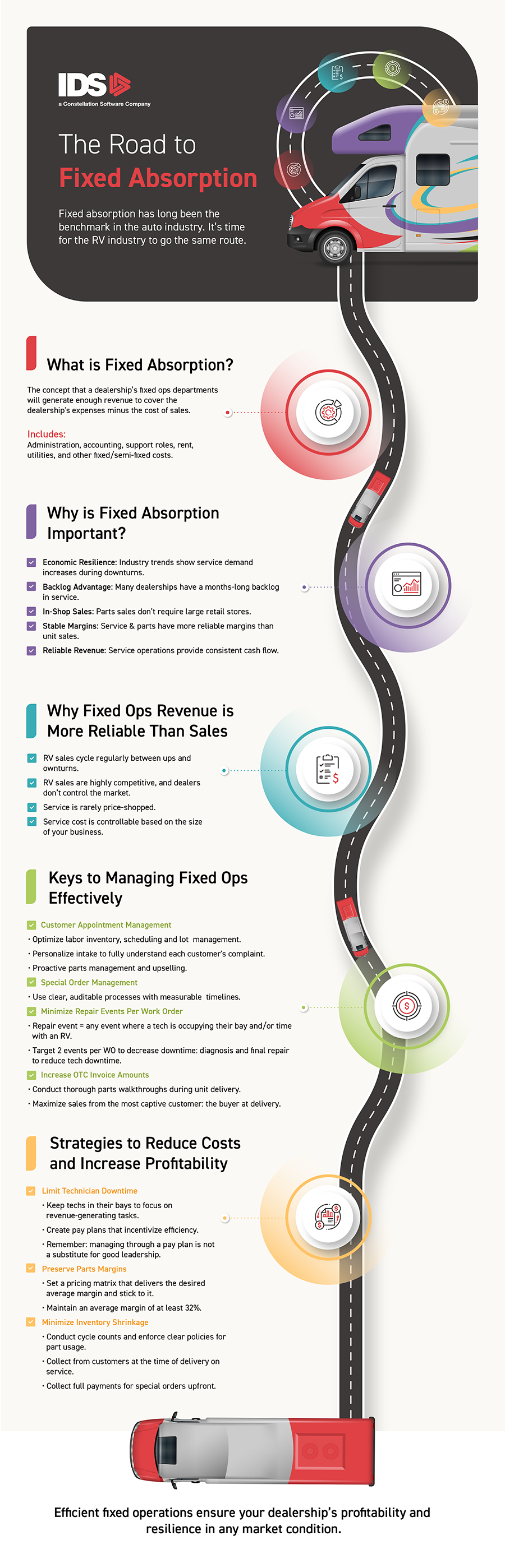
Fixed absorption is the concept that a dealership’s fixed operations departments generate enough revenue to cover the dealership’s expenses, excluding the cost of sales. These expenses typically include administration, accounting, support roles, rent, utilities, and other fixed or semi-fixed costs.
When fixed ops can absorb these costs, unit sales become a growth opportunity rather than a necessity for survival.
Why Fixed Absorption Matters for RV Dealerships
Fixed absorption is especially important in the RV industry due to the nature of its sales cycles and service demand.
Service demand often increases during economic downturns, providing a natural buffer when unit sales slow. Many dealerships already have months-long backlogs in their service departments, creating a built-in revenue advantage. Parts sales also require far less overhead than unit sales, as they don’t rely on large retail showrooms.
In addition, service and parts departments tend to deliver more stable margins than unit sales. Combined with consistent cash flow from service operations, fixed ops revenue becomes a dependable foundation for the dealership’s overall financial health.
Why Fixed Ops Revenue Is More Reliable Than Unit Sales
RV sales regularly cycle between periods of growth and decline, and dealers have limited control over broader market conditions. Competition is high, and pricing pressure is constant.
Service, on the other hand, is rarely price-shopped. The cost of service is also more controllable, as it scales with the size and structure of the business. This makes fixed ops a far more predictable and manageable source of revenue compared to unit sales.
Keys to Managing Fixed Operations Effectively
Customer Appointment Management
Effective appointment management helps optimize labor inventory, scheduling, and lot management. Personalizing the intake process ensures a full understanding of each customer’s complaint, while proactive parts management and upselling help maximize revenue per visit.
Special Order Management
Special orders should follow clear, auditable processes with measurable timelines. This ensures accountability and reduces delays that can disrupt workflow and customer satisfaction.
Minimizing Repair Events per Work Order
A repair event is any instance where a technician occupies a bay and time with an RV. Targeting two repair events per work order—diagnosis and final repair—helps reduce downtime and keeps technicians productive.
Increasing Over-the-Counter (OTC) Invoice Amounts
Conducting thorough parts walkthroughs during unit delivery creates an opportunity to maximize parts sales. The most captive customer is the buyer at delivery, making this an ideal time to increase OTC revenue.
Strategies to Reduce Costs and Increase Profitability
Limit Technician Downtime
Keeping technicians in their bays ensures they remain focused on revenue-generating work. Pay plans should incentivize efficiency, but strong leadership remains essential—managing solely through compensation plans is not a substitute for effective management.
Preserve Parts Margins
Establish a pricing matrix that delivers the desired average margin and adhere to it consistently. Maintaining an average parts margin of at least 32% helps protect profitability.
Minimize Inventory Shrinkage
Regular cycle counts and clear policies for parts usage are critical. Collecting payment from customers at service delivery and requiring full payment upfront for special orders further protects cash flow and reduces losses.
Building a More Resilient Dealership
Efficient fixed operations are the foundation of dealership profitability and long-term resilience. By focusing on fixed absorption, RV dealerships can better withstand market fluctuations, reduce reliance on volatile unit sales, and build a more stable, sustainable business in any market condition.